

This morning was our oyster lesson and cooking masterclass at The Table Culinary Studio, here on Prince Edward Island. We got up at an unnaturally early hour (after sunrise, though) and drove across the island to New London, where the cooking school is located. We parked up in front of a beautiful old church, which we later learned had only stopped being a church 5 years ago!
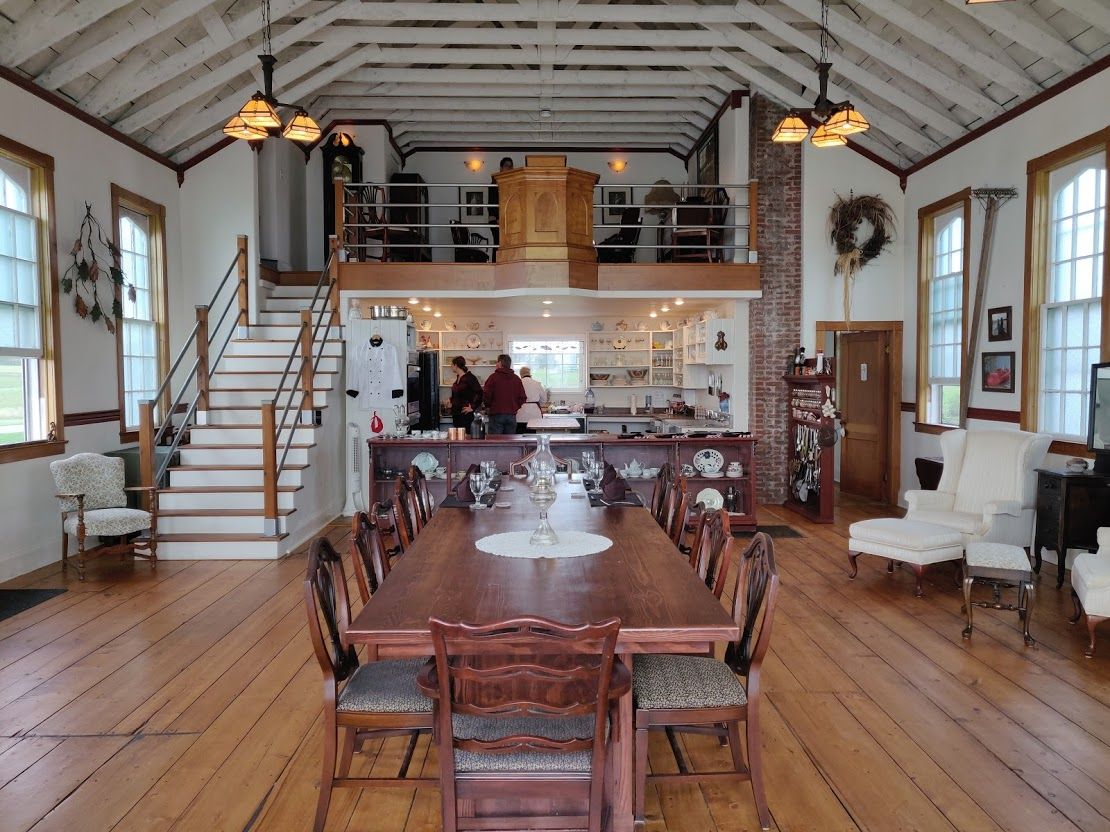
Inside we were introduced to Chef Derrick the owner, Chef Taylore who would be teaching us how to cook oysters, and Christine who would organise and run our morning. Only two others had booked a spot on the course; a couple about our age from Toronto. We spent a few minutes socialising and looking around the building. They had converted the old bell tower into a cookbook library, and added a beautiful spiral wooden staircase to climb up, creating a little nook overlooking the rest of the church.
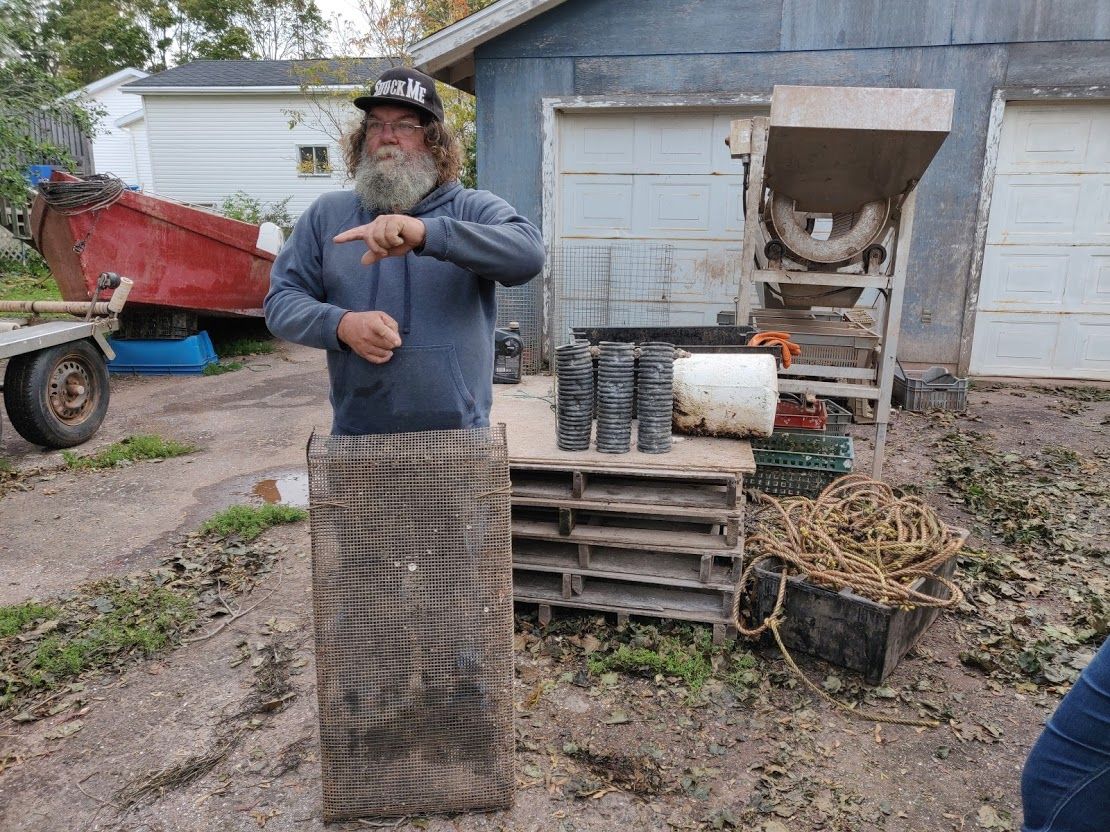
Soon enough, we were gathered up and headed across the road to meet George, a local oyster farmer who grows Green Gables oysters. We stood in his driveway for about an hour while he gave us a rundown of the life cycle of the oyster.
Once per year, oysters release sperm and eggs into the water, which become fertilised and look for nice clean locations to settle onto. In the wild this would include other oyster shells, rocks, and even sometimes seaweed. In George’s aquaculture operation though, he wants to collect as many of these fertilised oyster eggs as possible. To do this, he has a contraption made of three 40cm long lengths of corrugated piping, roped together in the same way you’d make a rope ladder. This and hundreds like it are dipped in cement to provide a good surface for the larvae to cling to, and once cured they’re all sunk in the bay where the oysters are spawning. Once sufficiently covered, they’re brought back to his house and the concrete is broken off by smacking them with baseball bats, and the rubble is run through a big rotary tumbler to try and separate the little oysters from the concrete.
The small oysters are then put into cages made of rigid plastic netting (sourced from France, apparently), and sunk into the bay. Every few months the rigs holding these cages are flipped over, so that the floats attached to one side hold the cages out of the water. Oysters can survive up to a week out of water, provided the temperature isn’t too high, but most other organisms like mussels and barnacles can’t. This process keeps the oysters nice and clean without having to use any chemicals or time-consuming labour.
Once a year or so the oyster cages are brought back to George’s place where they’re run through the tumbler again. Even though this looks like a traumatic experience, it doesn’t damage the oysters very much. Instead, it encourages them to build thick, hard shells, and to develop a deep cup shape which is very sought after in the North American market. It also further helps to keep them clean, by polishing off anything that might be living on the outside. This continues for 3 to 4 years until the oysters are large enough to harvest. I had no idea they took that long to grow!
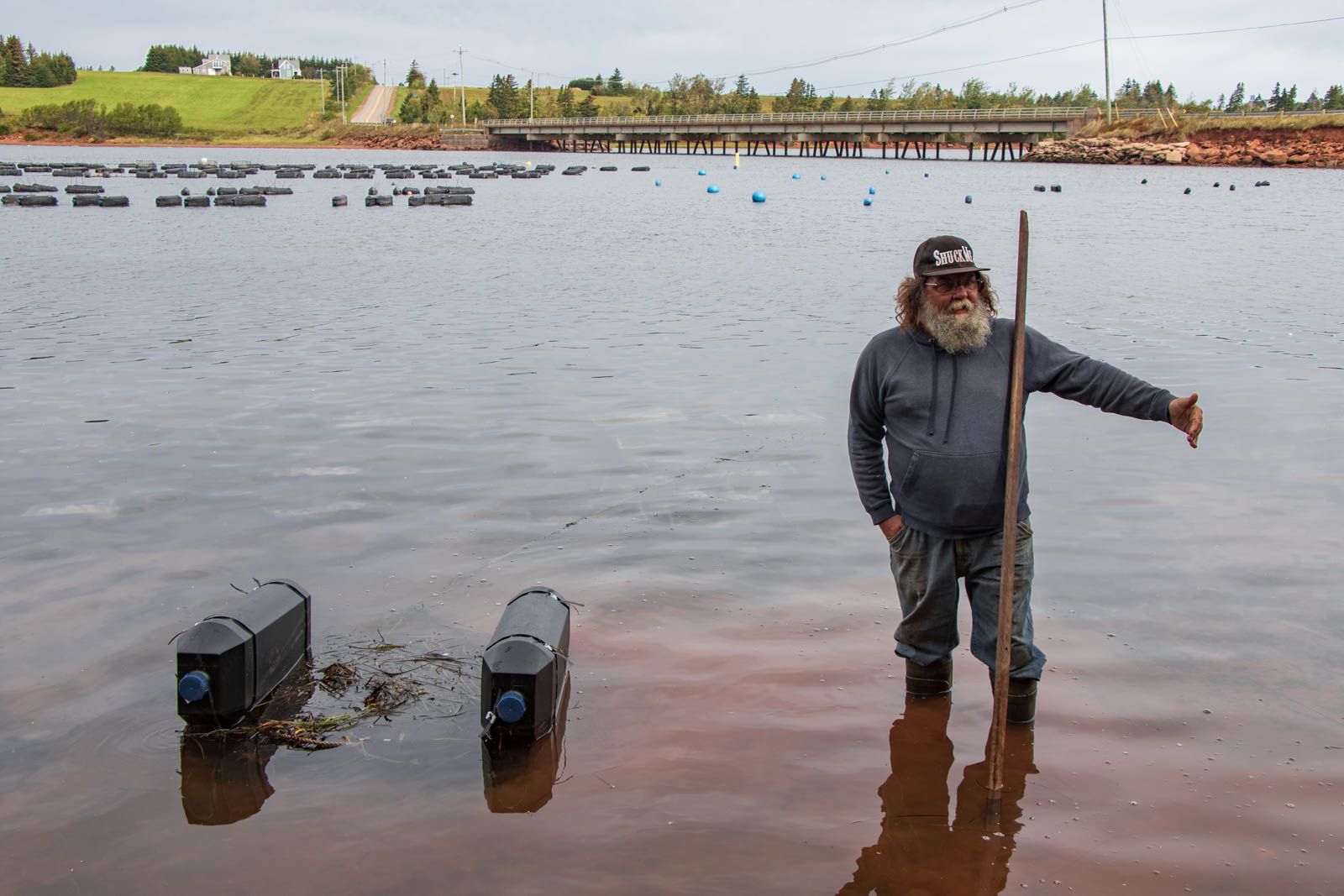
We then drove a few minutes down the hill to the shore where we found one of George’s leases, which is a section of water that he leases from the government. The lease gives him sole right to farm oysters in the water column and on the seabed, and is marked out by some bright yellow buoys. He pointed out some other leases across the other side of the river which had no visible oyster line floats, and told us that those leases only gave the leaseholder rights to the sea floor.
There’s two main ways to farm oysters; the small seed oysters can be spread over the ocean floor within a defined area, or they can be distributed in cages and floated in the water column. Growing the oysters on the sea floor is a cheaper method as no oyster lines, cages, and floats are required, but it entails a lot more manual labour to dredge the mollusks up.
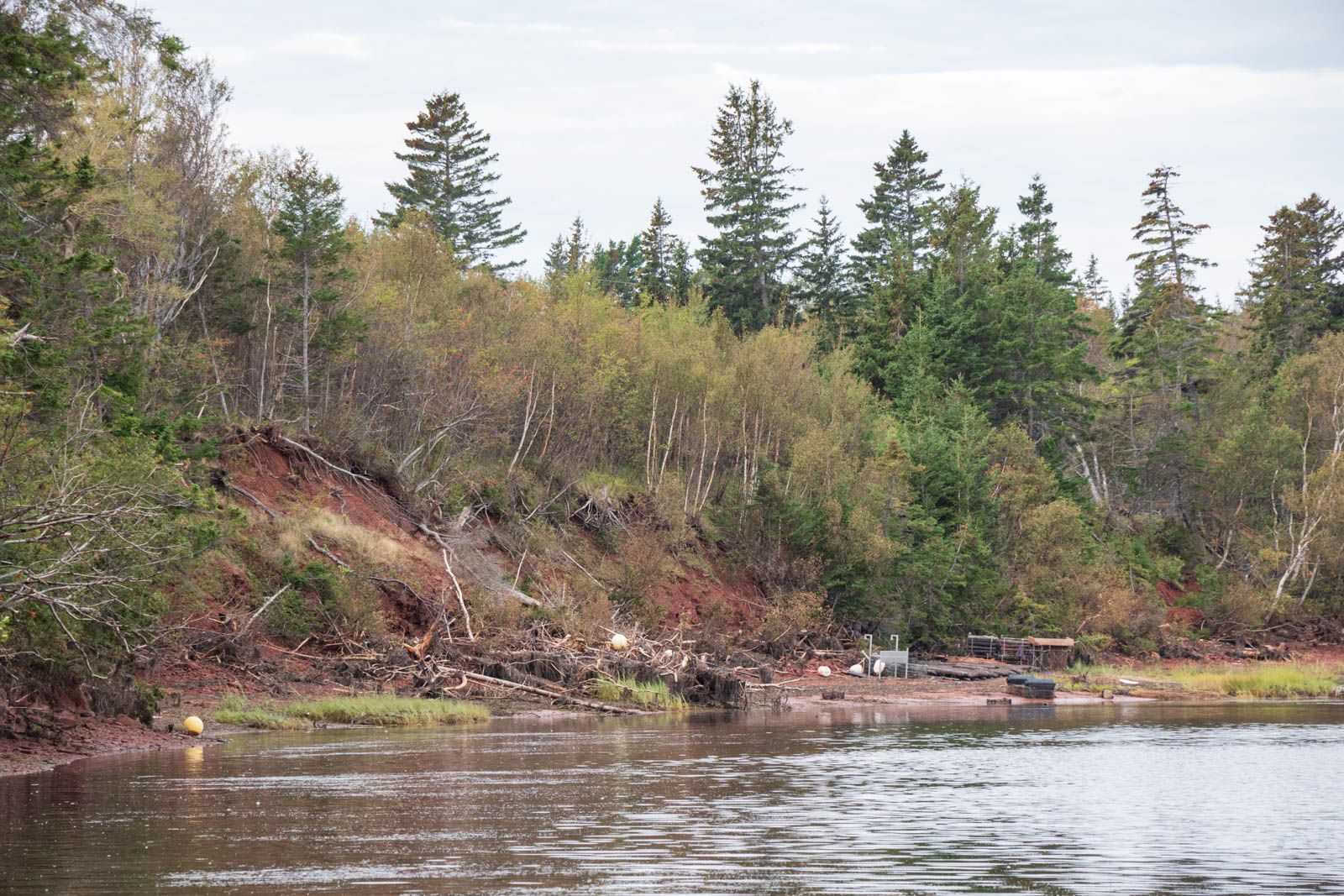
The storm had hit this side of the island harder than anywhere else on PEI, and there was carnage everywhere. The beach was littered with bits of tree, huge amounts of seaweed, and floats from nearby aquatic farms. George said that his oyster lines hadn’t been too damaged by the storm, but they had been pushed around a lot and were no longer in neat straight lines stretching across his piece of water.
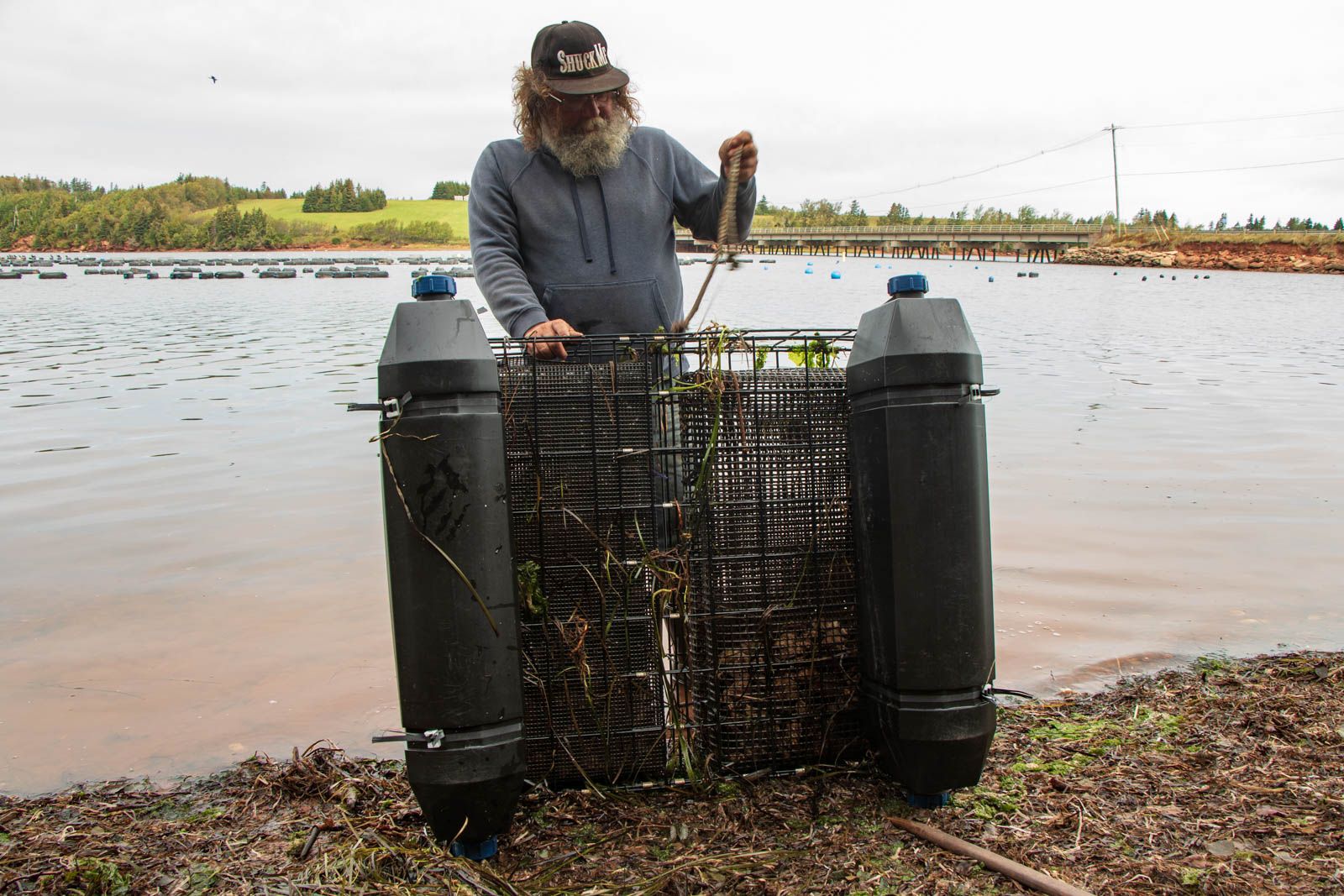
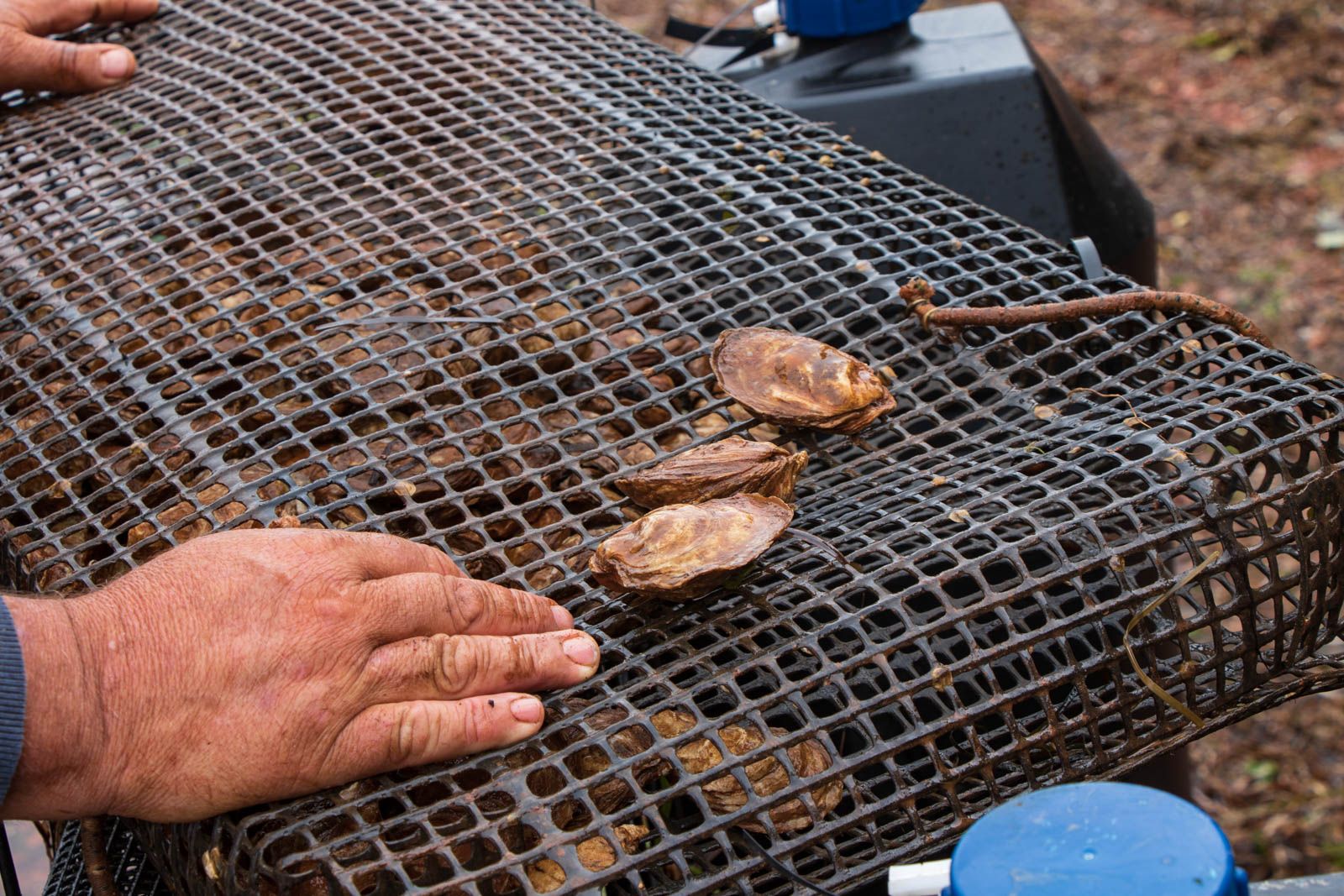
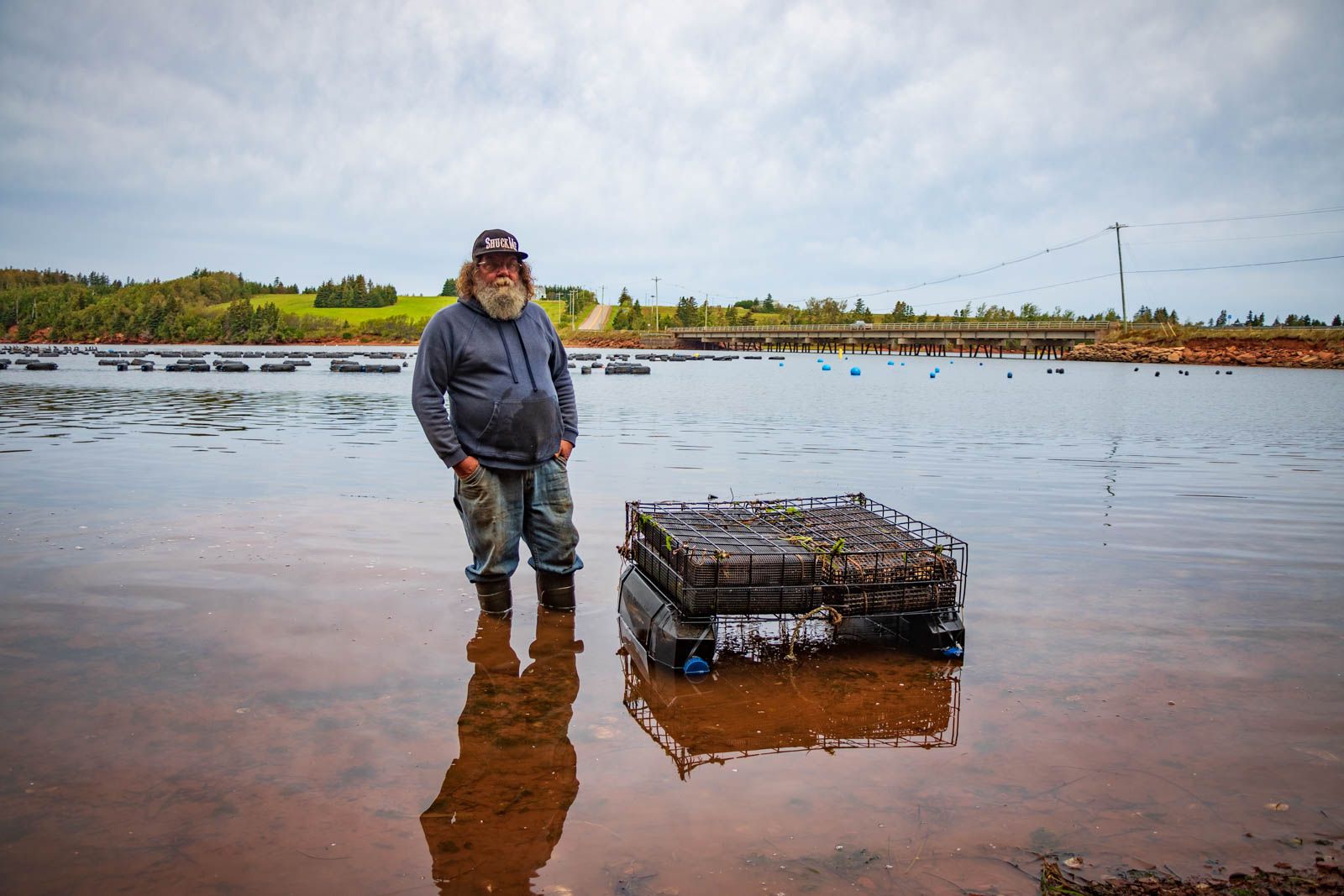
He waded out into the water and hooked a floating cage that was near the shore. This looked out of place and I thought it had come loose during the storm, but he told us that he kept it here for demonstration purposes. In it there were four cages of oysters, each at different stages of maturity. He pulled each one out in turn and showed us the growth of the oysters, as well as the evidence of other creatures that had started to grow in and around the cages. Clacking two of the oysters together with a sound like two marbles hitting each other, he showed us how solid and durable they were and what a healthy oyster should sound like.
The floating rig itself was made of thick wire grill, kind of like a dog kennel or temporary fencing, bent into a flat box shape. On one side of this two floats were attached, such that if the rig is one way up the floats hold the box underwater, and when flipped the floats act like pontoons to hold it up in the air. The box perfectly fits four of the oyster cages, which slot in like pizza boxes. Each of these rigs are connected with a short piece of rope to a larger line that is strung across the bay, to create an “oyster line”. All the individual parts are made of basic and simple materials but constructed in a way that made the whole process work very easily and perfectly. There didn’t seem to be any sacrifices made in functionality by using this design; you didn’t need purpose built oyster farming equipment from an expensive supplier (other than the plastic that the cages were made out of, and that was just because George found this French supplier to make more durable netting than anyone else).
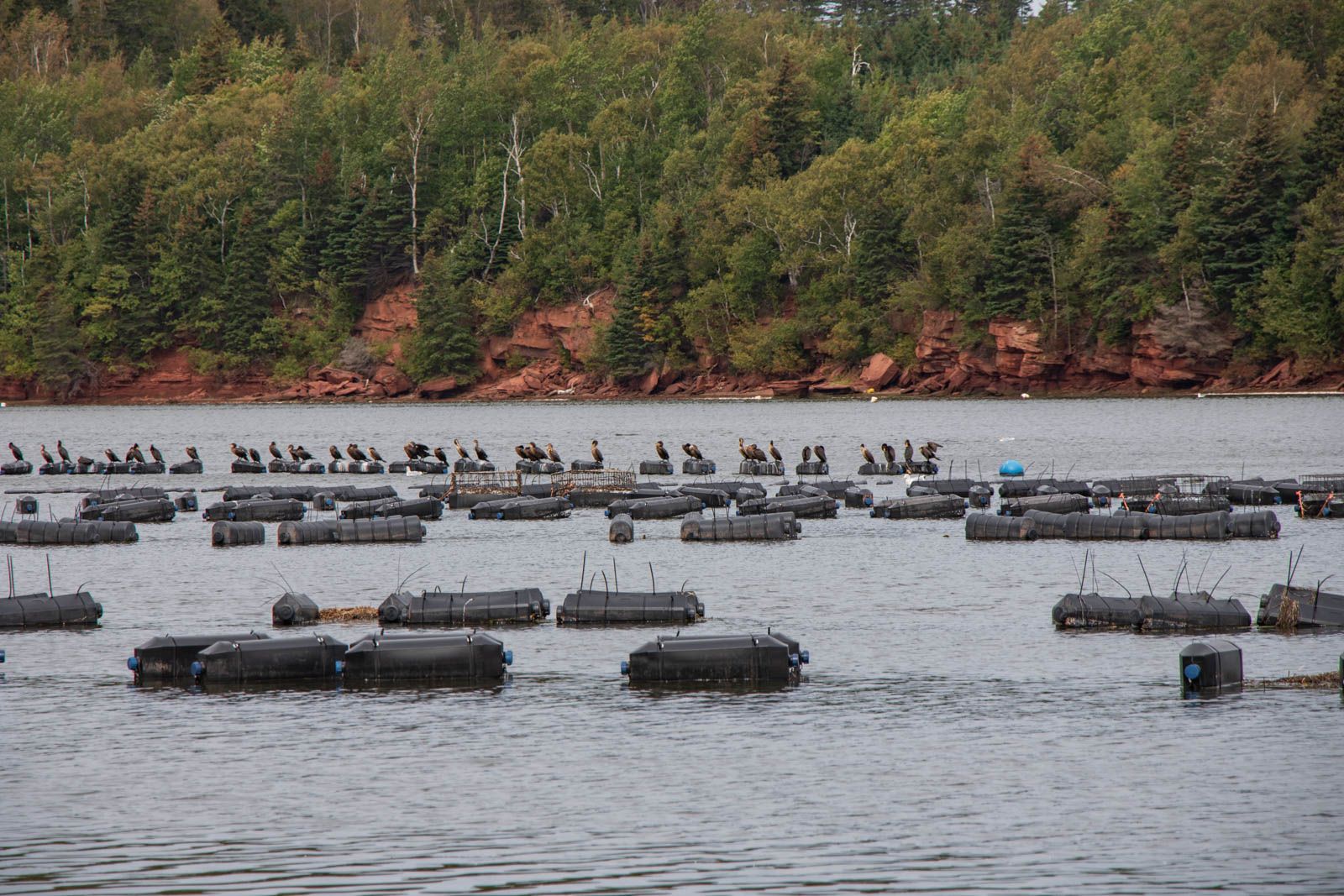
Once the oysters are ready to harvest, they’re removed from the cages and put in baskets, which are then sunk just off the shore where they sit for 21 days. Birds like to roost on the floats when they’re sitting out at sea, which results in everything becoming covered in bird poop. By letting the oysters sit underwater for the last three weeks, they have time to flush any impurities and pollution out of their systems. This waiting period is enforced by the Canadian and American food safety organisations. George uses this opportunity to bathe his oysters in the water coming from some artesian springs that exit just off the coast, which gives his oysters distinct flavour characteristics (he compared it to terroir with wine).
These organisations also enforce mandatory seven day waiting periods after heavy rain, because of the runoff from farms and other land-based pollution sources which could contaminate the water. The recent hurricane had triggered this stand-down, so George couldn’t let us try any of the oysters fresh from the sea. He told us that pretty much all PEI oyster farmers are very careful about following these guidelines, as the reputation of the “PEI Oyster” is at stake if someone gets sick from eating one, regardless of which farm it came from.
Back at The Table George showed us how to shuck an oyster, which he made look very simple, but is definitely an art form. There are global competitions for the world’s fastest shuckers! To start, you lay the oyster cup-down on a towel in front of you, with the hinge facing your dominant hand. With your non-dominant hand, you fold the towel over the top of the oyster and grip it strongly. In your other hand you take a thin chisel-shaped knife and push into the hinge with lots of force, and wiggle it just as you would if you were trying to pry it open with a flat-head screwdriver.
As the hinge begins to give way, the top of the shell starts to move, and you can reduce the force that you’re pushing with. Finally, the end of the shell lifts a bit, and you can get your thumb into the gap to hold it open. You give your knife a wipe to get any crushed shell or other grit off it, and then slide it into the gap you’ve created, all the way along the inside of the shell until it cuts the muscle that holds the shell closed. Then the top of the shell just pops off!
Now you have your open oyster, but the meat inside is still joined onto the shell underneath. The next step is to spin the shell around 180 degrees, and then use your knife to scrape under the meat to release the other side of the shell-closing muscle. All throughout this process you have to be careful to not introduce any dirt from outside into the meat, and not spill any of the liquor (the watery liquid inside the shell). Once that’s taken care of, you carefully plate the oyster and it’s ready to eat!
Our first tasting was with a variety of mignonettes (vinegar-based sauces) which George had prepared earlier. Several of them were fresh, with herbs he’d picked last night, and two others had been marinating for several weeks. We spooned little bits of the sauce into the oysters we’d shucked earlier and gulped them down! Oysters have quite a delicate flavour, so you have to be careful not to overpower them with condiments, especially ones like these with very strong flavours. We each ate four or five each.
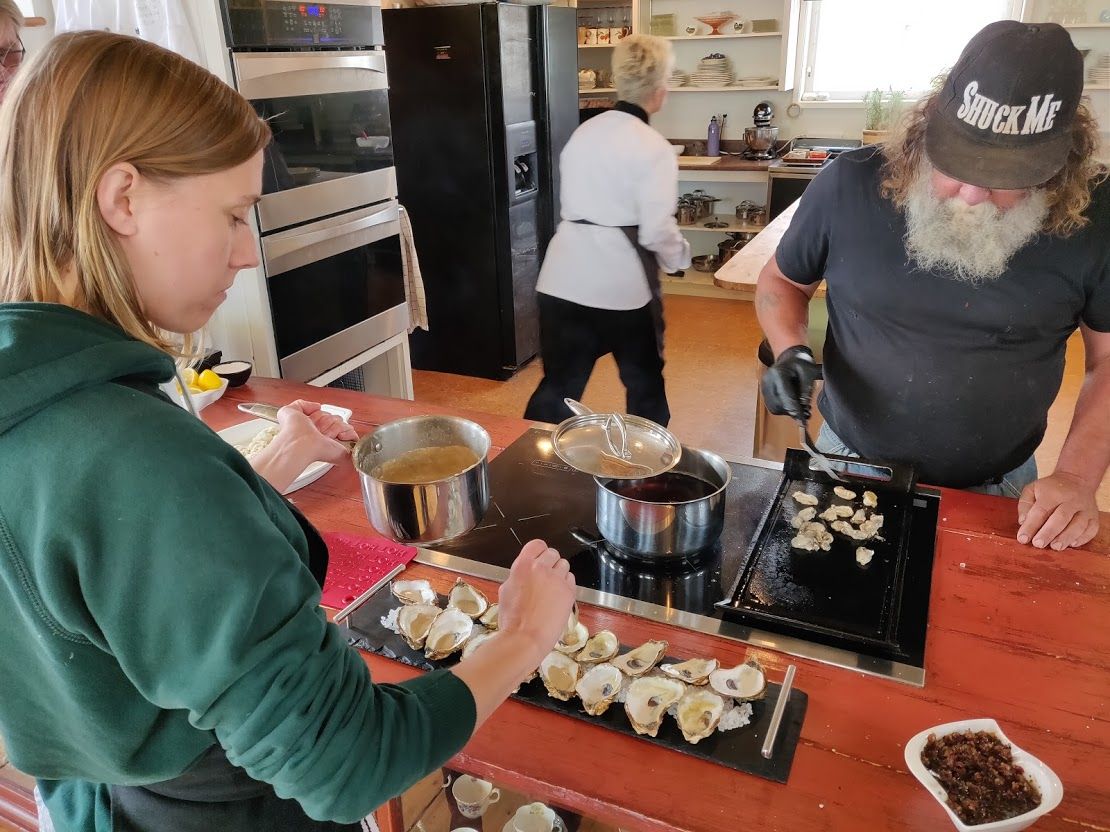
Our second taste was with two sauces that we made as a team under the direction of Chef Taylore; an onion and bacon jam, and a white wine and black garlic cream sauce. This time, the oysters were removed from their shells and seared on a hotplate. Katie spooned some of the cream sauce into the empty shells, and once the meat was ready it was popped back in and a little dollop of jam put on top. This was probably my favourite combination of flavours, of everything we tried today.
The final meal, which was going to be a proper sit-down lunch, was a fried oyster po’ boy. We began by double-crusting 32 oysters with egg and a mixture of masa flour, cornmeal, and some herbs and spices. We then deep-fried these in two batches in a pot of canola oil, with each batch only taking a couple of minutes. Meanwhile, we heated up some halved ciabatta buns on the hotplate, to give them a nice crispy inside. The final step was to sear some lemons by cutting them in half and patting the cut surface dry, pressing them into a bowl of salt, and then putting them cut-side down in a ripping-hot pan. Once we could see the lemons starting to brown, we turned the heat down and left them to heat all the way through.
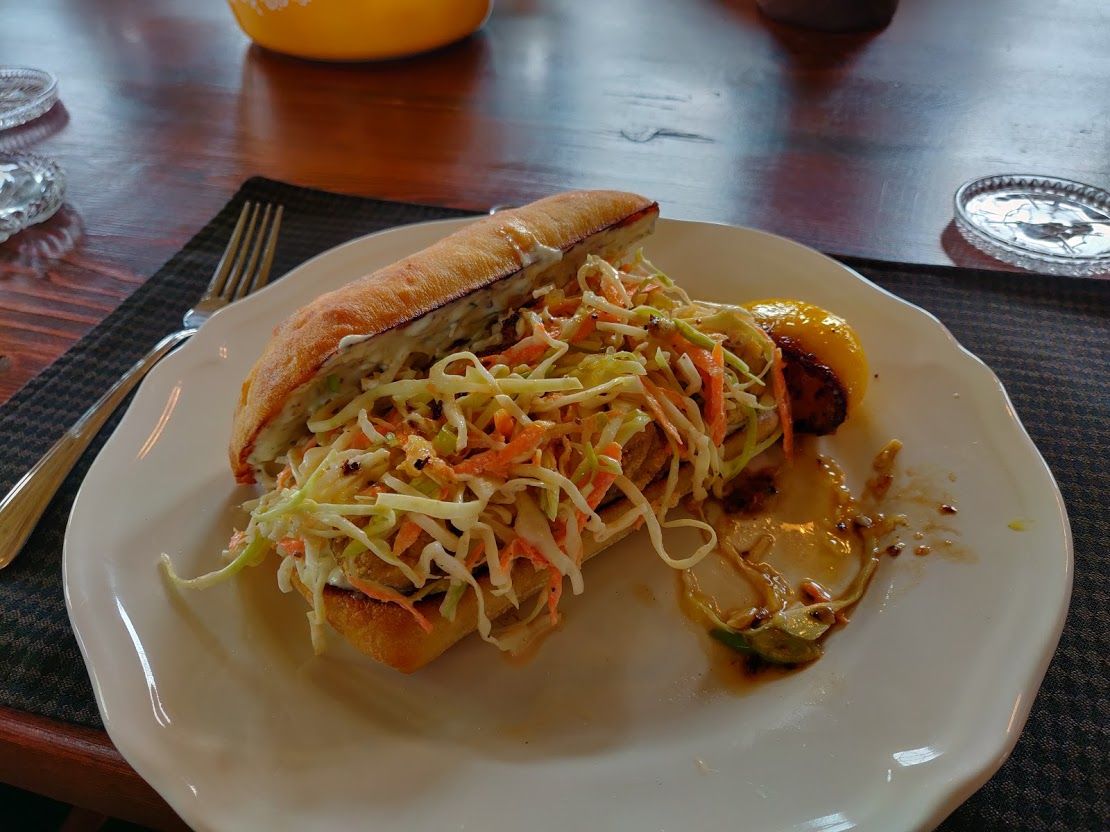
Chef Taylore had made some coleslaw while we were out learning about oysters using her own special recipe. She told us that letting it rest for at least half an hour after you make it makes the eating experience a lot better, because once it comes up to room temperature it won’t cool down all the hot ingredients that go into the po’ boy, and also it allows the flavours in the sauce to develop better. We spooned generous helpings of some remoulade sauce she’d just made onto both halves of our bread, added eight fried oysters each, and then topped with a large heap of coleslaw. Yum!
The four of us sat around the dining table and messily ate our sandwiches, while drinking some beers and answering the questions we get asked all the time about the comparisons between Toronto, Canada, and New Zealand. We also had a bowl of barbecue chips made by a local PEI producer, which is a traditional side to a po’ boy.
When we’d finished eating and said our goodbyes, we staggered out to the car and sat for a while in a borderline food coma. While we were out on this side of the island, we decided that we should visit the Cavendish coastline, and stop in to see the Anne of Green Gables house. Even though we really just wanted to lie down, we drove on to Cavendish National Park.
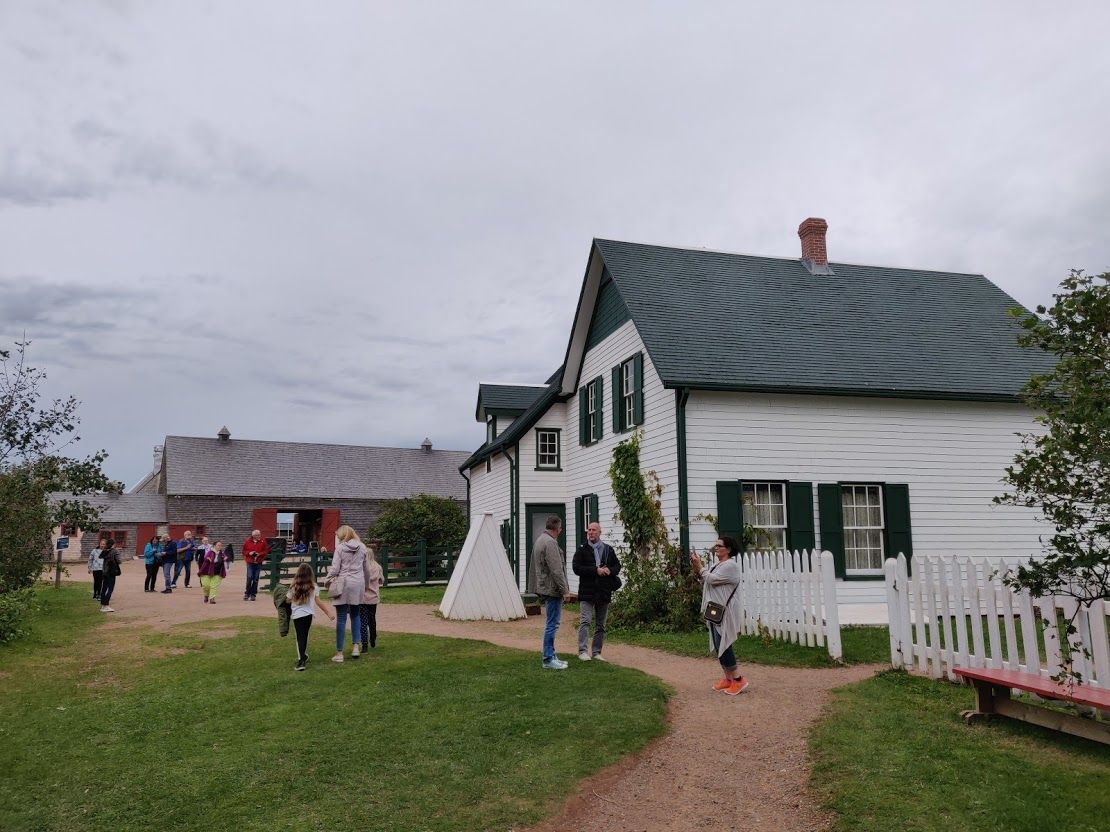
The Anne of Green Gables house is the original house that inspired Lucy Maud Montgomery to write her classic children’s novel way back in 1908. It has been preserved in a National Park and refitted with furnishings that match the description of the house from the book. Neither Katie nor I have read the book, so we didn’t really know what to expect (or have enough background to properly appreciate it), but we enjoyed looking through the house and learning about L.M. Montgomery in the nearby interpretive centre.
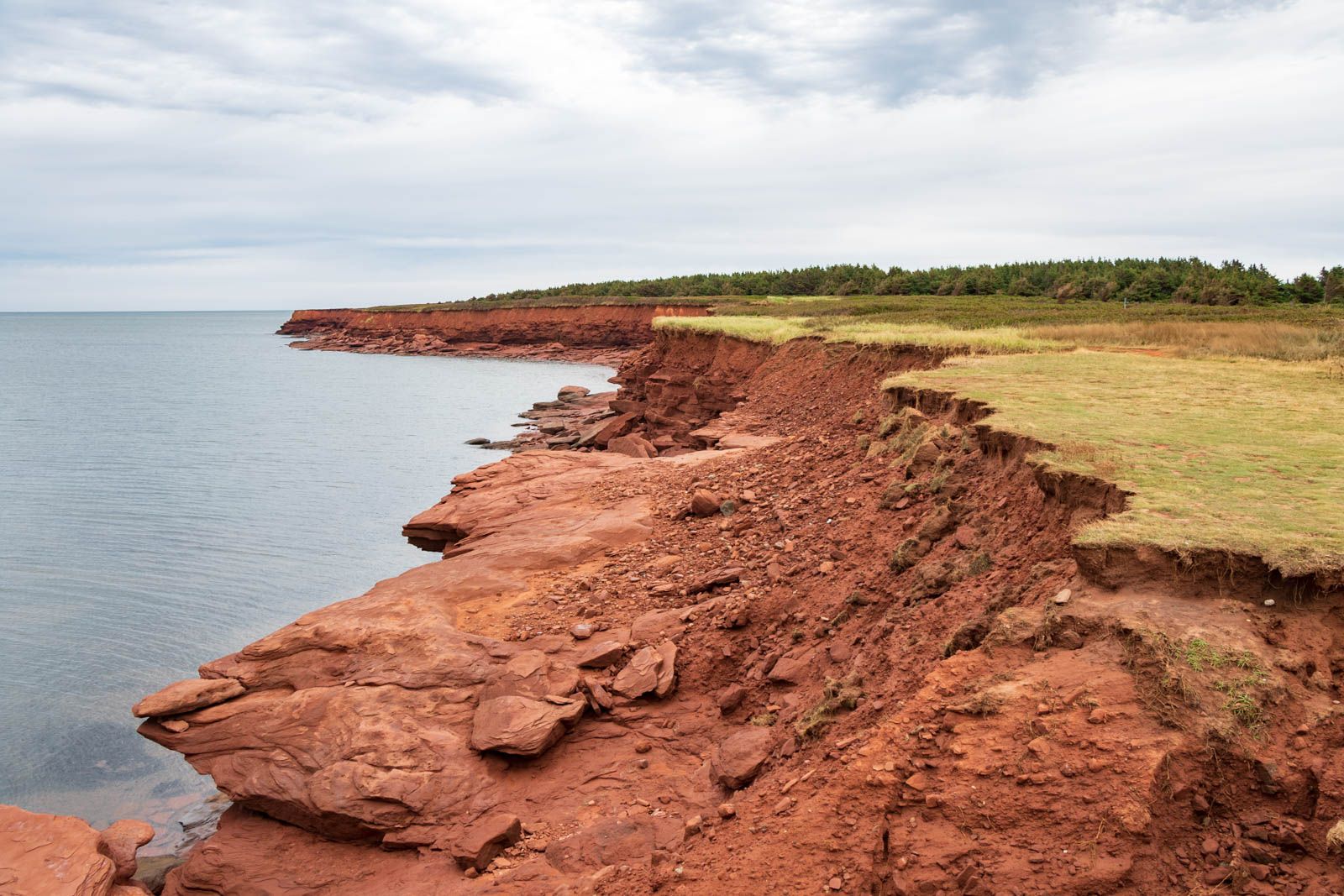
Our final sightseeing tour for the day was along a coastal road, where we stopped several times to look at the incredible erosion that the storm had caused. The island is made primarily of red iron-rich sandstone, which looks incredible when contrasted with the deep green of the grass and trees, but doesn’t stand up well to the wind and sea. The island is eroding reasonably rapidly at the rate of about one metre per year, but the hurricane caused two metres of erosion in a single weekend! Along with the damage to the shoreline, we saw lots of snapped and fallen trees. George had told us he saw a drone photograph of Cavendish, and they had lost almost 80% of their trees.